

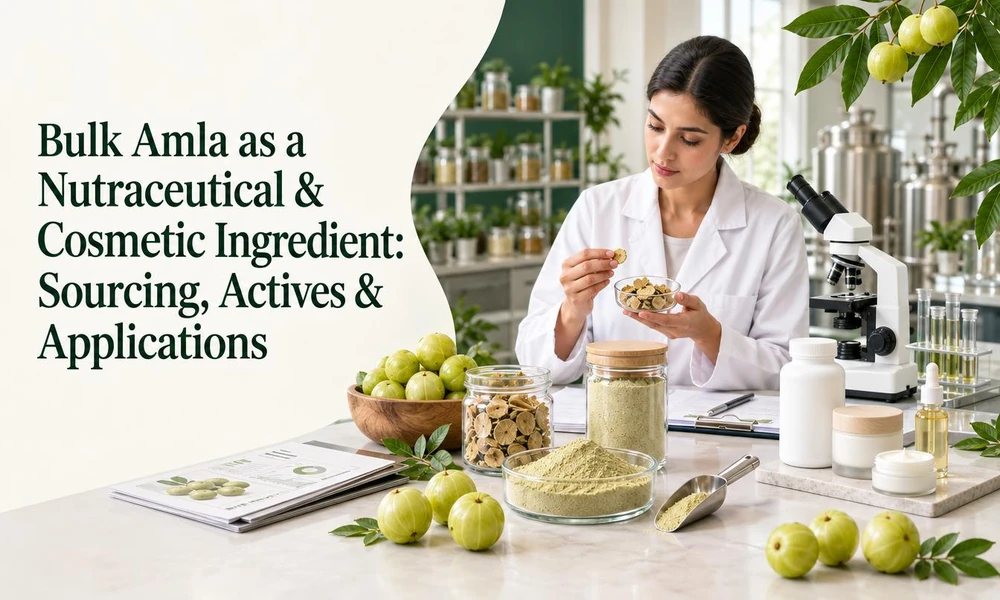
Amla at a Glance: Botanical Profile & Industrial Relevance
Amla holds a well-established position within health practices of South Asia, the question for formulation companies trying to build a nutraceutical or cosmetic line, the primary consideration is different: how do you obtain this ingredient in a manner that allows consistent quality and large-scale sourcing? This guide addresses the key factors relevant when phyllanthus emblica raw material transitions from an Ayurvedic staple into a formal specification sheet.
Scientifically, the amla is the fruit from the Indian subcontinent of a small deciduous tree that has been used in Ayurvedic medicine for centuries before the term “superfruit” became widely recognized. Harvesting occurs during certain seasons, usually from October to February, and hence planning for procurement must take into consideration that harvest period to obtain fresh fruits and high-active material rather than aged stock.
Market Demand & Why Brands Are Sourcing It Now
Interest in this ingredient continues to increase, owing to clean label positioning and Ayurvedic formulation products finding their way onto store shelves across both Eastern and Western markets.For brands that are looking for organic amla wholesale export requirements, the competition is growing because of the limited availability in harvest supply. This forces brands to make sourcing decisions earlier on in the year than many procurement departments expect.Combined with rising demand in immunity-support categories, sourcing pressure is expected to remain significant.
Actives: Natural Vitamin C, Tannins & Polyphenols
The importance of amla lies not in its traditions but in the composition of its chemistry. The fruit also possesses one of the highest natural levels of vitamin C concentration of any edible plant, as well as tannins, gallic acid, and other polyphenolic compounds that are responsible for its antioxidant capacity. Formulators sourcing amla vitamin c natural ingredient bulk quantity suppliers must provide assay verification data instead of presuming that there is a consistent percentage across every harvest.
Nutraceutical Applications
Among the various uses for amla in nutraceutical formulation include capsules for boosting immunity, digestive health products, hair and skin supplements, and antioxidant formulas. Brands developing amla for nutraceutical formulation products typically specify between standardized extracts and whole fruit powders based on the labeling strategy of whether it includes a clinical claim or a traditional whole food approach.
Cosmetic & Personal-Care Applications
The use of this ingredient in personal care is perhaps the most rapidly expanding application field. Hair oils, shampoos, and serums often mention the ingredient’s ability to nourish the scalp and hair strands, whereas the skincare products incorporate the ingredient because of the brightening and antioxidizing properties. The extraction process for the use of amla extract in cosmetics involves careful consideration of its solubility, its color stability in the final product, and whether the extract is standardized for tannins or polyphenols.
Formats & Quality Specs
Raw material is available in a range of forms suited to different production requirements. Options include whole dried fruit, deseeded flakes, coarse granules, fine powder, spray-dried TBC (tannin-based complex) extract, and tablet-ready compressions. Sourcing bulk amla fruits powder with consistent particle size is particularly important, since mesh variation between lots can affect blending accuracy on the production floor.
Bhumi Amla vs Amla – Specifying the Right Botanical
It is worth noting that “Bhumi amla” refers to another species, which is Phyllanthus amarus. It is separate from Phyllanthus emblica despite the overlapping common name creating confusing nature of the shared name in purchasing orders. This is inaccurate, and mistakenly combining these two plants on a specification sheet represents a documentation error that should be caught before it appears on the label.
Certifications & Export Compliance
Export-ready amla should be accompanied by more than a standard price quote. Buyers should request organic certification where applicable, heavy metal and pesticide residue reports, microbial testing, and, for those positioning as a downstream partner of an Indian gooseberry powder supplier, traceability documentation back to the growing region. Without supporting documentation, claims of “organic” or “wild-harvested” carry limited assurance.
How to Evaluate a Bulk Amla Supplier
Evaluating a supplier properly requires going beyond price quotes and sample photographs. Several factors are worth confirming before committing to a bulk amla powder supplier:
- Request a recent Certificate of Analysis with actual vitamin C and tannin figures, not general ranges
- Confirmation regarding harvest period and whether stock is fresh or held over from previous years
- Verification of heavy metals, pesticide, and microorganism tests on all shipments
- Clearance of minimum order quantity, time for delivery, and sample before bulk purchase
Though due diligence should not be used as an alternative to interacting with the potential suppliers, it certainly cuts down the number of suitable ones. Where there are difficulties in providing necessary documentation by the supplier, it could indicate larger problems with quality assurance practices.
Frequently Asked Questions
Q: Do you supply Phyllanthus emblica (Amla) and Phyllanthus amarus (Bhumi Amla) separately?
A: Yes, these botanicals are sourced, tested, and documented separately. Conflating the two on a specification sheet is a common error, as their activities and traditional uses differ significantly.
Q: Is your amla suitable for both nutraceutical and cosmetic (hair/skin) formulations?
A: It can be, depending on the grade selected. Standardized extracts suit clinical-style nutraceutical claims, while cosmetic-grade material is tested for solubility and color stability.
Q: What forms are available – fruits, flakes, seedless, granules, TBC, powder or tablet?
A: Reliable suppliers typically offer whole fruit, Amla seedless fruits, deseeded flakes, granules, fine powder, TBC extract, and tablet-ready compressions, allowing particle size to match production needs.
Q: How is natural vitamin C / active content preserved during processing?
A: Low-temperature drying, minimal handling, and prompt post-harvest processing help preserve vitamin C content. Suppliers should provide verified assay data rather than a standard estimate.
Q: What are your MOQ, packaging and export options for bulk amla?
A: These vary by supplier and harvest volume. Buyers should clarify minimum order quantities, packaging formats, and lead times directly, and request samples before large orders.
Partner With a Certified Amla Supplier
Selecting the appropriate amla partner ultimately depends on transparency: accurate testing results, regular harvest-based sourcing, and an ability to deal with specifications questions directly. When buyers adopt this approach at the very start, they usually manage to avoid production interruptions in the middle of the process, which carry a far greater cost than a modestly higher per-kilo price.
